Deep Dive · Nov 27, 2026 · 7 min read
Operating GenAI in Production: Observability, Drift, and Incident Response
What to monitor, how to detect quality drift, and how to run incidents for non-deterministic systems.
 Short version← After Launch: Keeping a GenAI System Healthy
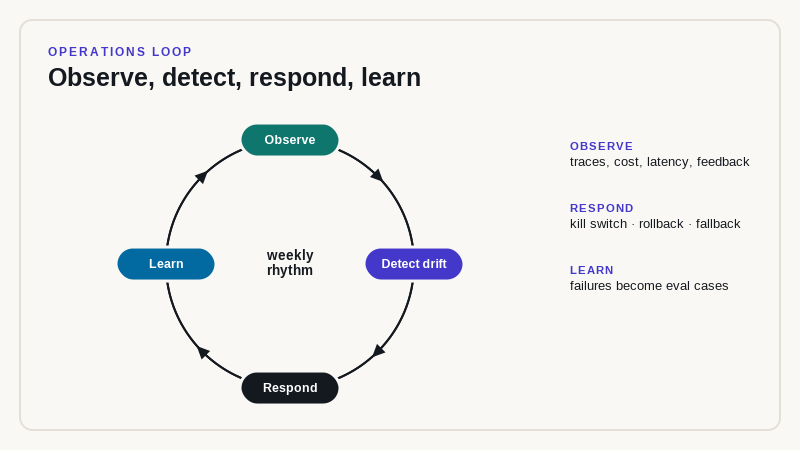
GenAI systems degrade without any code change. Documents change, providers update models, and users ask new things. Operating them means observing behavior, detecting drift, and having a way to respond.
Trace every request
{
  "trace_id": "9f3c...",
  "ts": "2026-11-26T09:14:03Z",
  "use_case": "support_copilot",
  "model": "large-v2",
  "prompt_version": "draft-v14",
  "retrieved_ids": [4412, 981, 7730],
  "input_tokens": 3120, "output_tokens": 287,
  "latency_ms": 2840, "cost_usd": 0.0121,
  "gate": "ok",
  "feedback": null
}
The example shows the fields to capture, not real values. Redact personal data from traces, and apply retention limits.
Metrics and alerts
- Reliability: error rate, timeouts, fallback rate.
- Latency: p50 and p95 per use case.
- Cost: spend per day and per request, with budget alerts.
- Quality: user feedback rate, edit ratio, and sampled review scores.
Detect drift
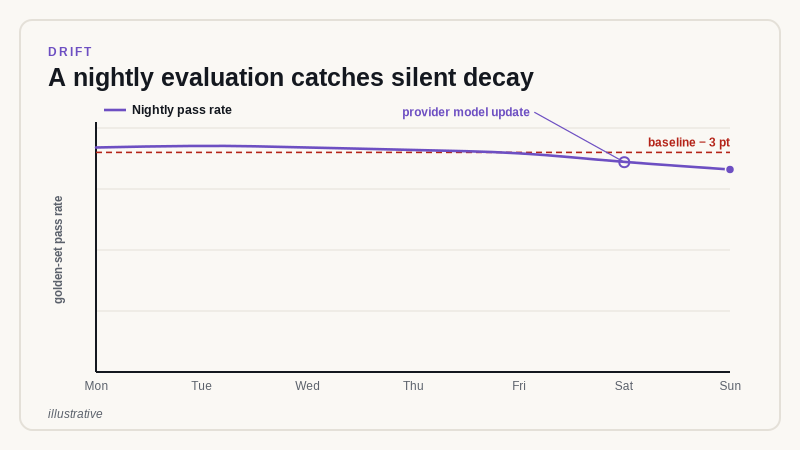
Run the golden set on a schedule, such as nightly, against the production configuration. A drop signals provider model changes or content problems. Also compare the distribution of input topics over time to spot new demand that your content does not cover.
def nightly_check(run_eval, baseline, tolerance=0.03, alert=print):
    result = run_eval()                               # same golden set, production config
    drop = baseline["pass_rate"] - result["pass_rate"]
    if drop > tolerance:
        alert(f"quality drop {drop:.1%}: failures={result['failures'][:10]}")
    return result
Incident response
- Have a kill switch that routes to a fallback or to humans.
- Define severity levels, such as wrong answers reaching customers.
- Keep a runbook: how to roll back a prompt or model version.
- Hold blameless reviews, and add the failing cases to the golden set.
def handle(request):
    if flags.enabled("copilot_kill_switch"):
        return legacy_process(request)
    return copilot_process(request)
Change management
Pin model and prompt versions. Roll out changes to a small share of traffic first, compare metrics, then expand. Review model deprecation notices from providers and schedule migrations.
Cadence
- Daily: alerts and the nightly check.
- Weekly: sample review and top failures.
- Monthly: cost, adoption, and model options.
- Quarterly: re-benchmark models and re-assess risks.
Dashboards that earn their keep
- Health: request volume, error rate, timeouts, and fallback rate.
- Speed: p50 and p95 latency by use case and stage.
- Spend: cost per day, per request, and per successful outcome.
- Quality: nightly evaluation score, feedback ratio, and edit ratio.
- Content: freshness of sources and index size.
Keep the main dashboard to one screen. Detailed views can live behind it.
Alerting with fewer false alarms
ALERTS = [
  {"name": "error_rate_high",   "expr": "error_rate_5m > 0.05",           "for": "10m", "severity": "page"},
  {"name": "latency_p95_high",  "expr": "latency_p95_15m > 8",            "for": "15m", "severity": "ticket"},
  {"name": "spend_anomaly",     "expr": "cost_1h > 3 * cost_same_hour_7d", "for": "30m", "severity": "ticket"},
  {"name": "quality_drop",      "expr": "nightly_pass_rate < baseline - 0.03", "for": "0m", "severity": "ticket"},
]
Thresholds are illustrative. Tune them from your own history, and review alerts that fire often without action.
Provider incidents
Keep the status pages of your providers on your radar, and test your fallbacks. During an incident, switch to the fallback model or to the manual process, tell users what is happening, and record the impact for the post-incident review.
Prompt and configuration management
- Store prompts, thresholds, and policies in version control.
- Deploy changes with the same review as code.
- Record the active version in every trace.
- Keep the ability to roll back in minutes.
Continuous improvement
Operations is also where the system gets better. Each week, review top failures and missing-content reports, ship the fixes, add the cases to the evaluation set, and watch the metrics. Over a few months this routine moves quality more than any single model upgrade, and it is the work we are most often asked to take on for clients.
How we can help
We set up tracing, evaluation schedules, and runbooks, and we can operate your GenAI systems on a retainer so quality stays high. Ask about a managed operations engagement.
Related reading
Need help implementing this?
Our consultants run architecture reviews and build production pilots. Book a free scoping call to talk through your design.
Book a Free Scoping Callor email us at hello@deepvero.com