Deep Dive · Oct 27, 2026 · 7 min read
Engineering an AI Enablement Program: Sandbox, Prompt Library, and Analytics
The tooling behind successful adoption: a safe sandbox, a shared prompt library, and usage analytics that guide training.
 Short version← Training Your Team to Work With AI
Training sessions fade without tooling that makes good behavior easy. An enablement program needs a safe place to practice, reusable assets, and data on what people actually do.
1. An approved sandbox
Give people an approved assistant so they do not use unsanctioned tools with company data. Configure single sign-on, data retention, and a clear policy on what may be pasted.
2. A shared prompt library
Store proven prompts as versioned templates with an owner, a description, and an example input and output. Treat them like code, with review and change history.
id: summarize-meeting
owner: ops-enablement
version: 3
description: Turn raw notes into decisions, owners, and deadlines.
inputs: [notes]
template: |
  You are an assistant for a business team.
  Summarize the notes below into: Decisions, Action items (owner, due date), Open questions.
  Use only information in the notes; write "unknown" when something is missing.

  Notes:
  {{notes}}
example_output: |
  Decisions: ...
3. Role-based training
Teach with each team's own tasks. Short sessions followed by a two-week challenge, such as automating one weekly task, work better than a long one-off workshop.
4. Usage analytics
Measure adoption without reading private content: active users, requests per user, template usage, and thumbs feedback. Use the data to find teams that need help and templates worth promoting.
SELECT team,
       COUNT(DISTINCT user_id)            AS active_users,
       COUNT(*)                           AS requests,
       AVG(CASE WHEN feedback = 'up' THEN 1.0 WHEN feedback = 'down' THEN 0.0 END) AS satisfaction
FROM assistant_events
WHERE ts >= date_trunc('month', now())
GROUP BY team
ORDER BY active_users DESC;
5. Governance
- A short acceptable-use policy in plain language.
- A review path for new use cases and prompts.
- A named owner who answers questions.
Defining roles
- Executive sponsor: removes blockers and sets the expectation that teams will experiment.
- Program owner: runs the plan, the metrics, and the communications.
- Champions: one respected person in each team who tries things first and helps peers.
- Security and legal partners: provide guardrails quickly, so teams are not left waiting.
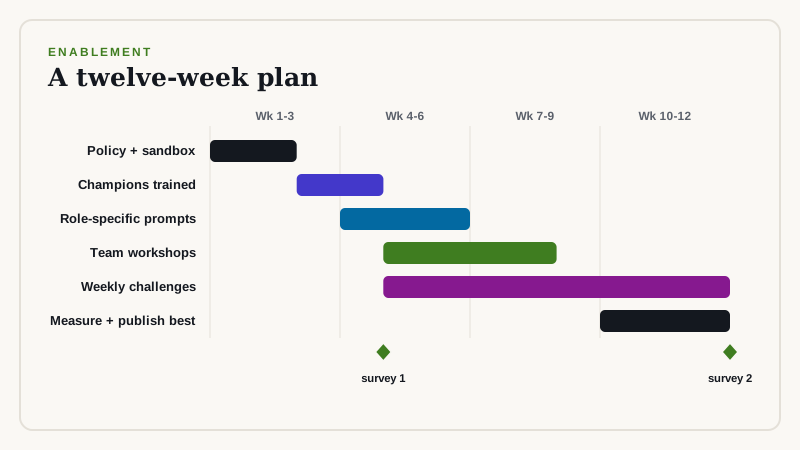
A 12-week plan
- Weeks 1-2: policy, sandbox set-up, and a baseline survey of current usage and attitudes.
- Weeks 3-4: champion training and the first set of role-specific prompts.
- Weeks 5-8: team workshops on real tasks, with a weekly challenge and a shared channel.
- Weeks 9-12: measure, retire what does not work, publish the best templates, and plan the next quarter.
Measuring outcomes, not attendance
SELECT date_trunc('week', ts) AS week,
       COUNT(DISTINCT user_id) FILTER (WHERE requests_in_week >= 3) AS regular_users,
       COUNT(DISTINCT user_id)                                       AS active_users
FROM (
  SELECT user_id, ts,
         COUNT(*) OVER (PARTITION BY user_id, date_trunc('week', ts)) AS requests_in_week
  FROM assistant_events
) t
GROUP BY 1
ORDER BY 1;
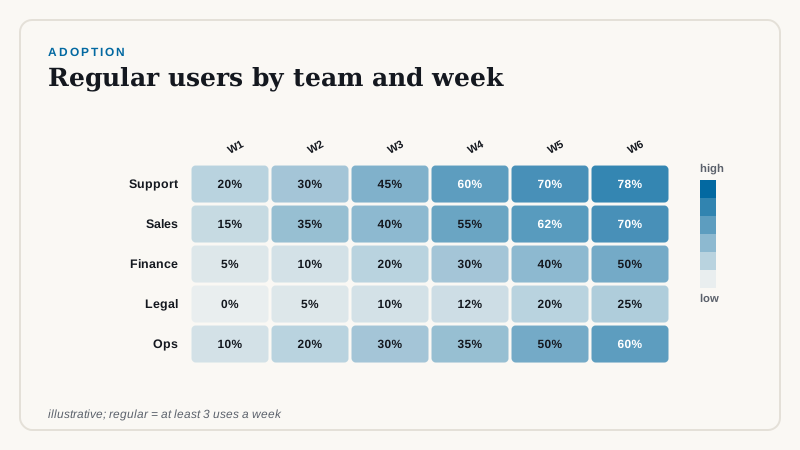
Regular users, such as people who use the tool at least three times a week, are a better measure than sign-ups. Pair it with a short quarterly survey asking what time the tool saves and what blocks people.
Prompt library governance
- Every template has an owner and a review date.
- Changes go through review, like code.
- Retire templates that are unused or that produce poor results.
- Tag templates by role, task, and risk level.
Handling risk without killing curiosity
Give clear red lines, such as customer personal data and unreleased financials in unapproved tools, and wide freedom elsewhere. People adopt tools they are allowed to use. A short, specific policy with examples works better than a long document nobody reads.
Sustaining momentum
Celebrate concrete wins with the person's name and the time saved. Hold a monthly show-and-tell. Refresh the library from real use, and make it easy to submit a template. Adoption is a habit that needs regular reinforcement for the first several months.
How we can help
We stand up the sandbox, seed the prompt library with your workflows, and run role-based training with measurable adoption goals. Ask for an enablement plan.
Related reading
Need help implementing this?
Our consultants run architecture reviews and build production pilots. Book a free scoping call to talk through your design.
Book a Free Scoping Callor email us at hello@deepvero.com