Deep Dive · Nov 24, 2026 · 7 min read
Technical Due Diligence for AI Vendors
A structured way to evaluate vendors: security, data handling, quality on your cases, reliability, and exit.
 Short version← How to Evaluate AI Vendors: Questions to Ask
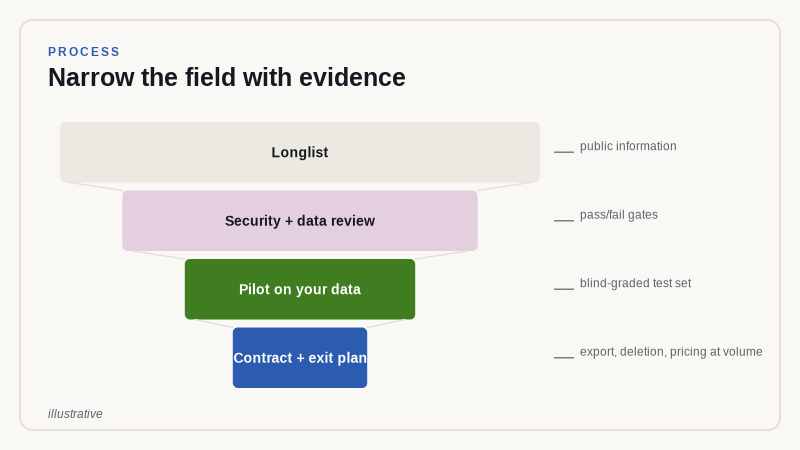
Demos are curated. A technical due diligence process replaces them with evidence on your data and clear answers to hard questions.
Security and compliance evidence
- Independent audit reports and certifications, and their scope.
- Penetration test summaries and remediation practice.
- Data flow diagram, including subprocessors.
- Incident history and notification commitments.
Data handling
- Where is data processed and stored, by region?
- Is customer data used for training or product improvement? Get it in writing.
- Retention periods, deletion on request, and backup behavior.
- Tenant isolation and encryption in transit and at rest.
Quality on your data
Run the same private test set through each vendor and score the results with the same rubric. Blind the vendor names in grading to avoid bias.
def compare_vendors(vendors, cases, grader):
    blinded = {f"V{i+1}": v for i, v in enumerate(vendors)}      # hide names from graders
    results = {}
    for label, call in blinded.items():
        outputs = [call(c["input"]) for c in cases]
        results[label] = {"quality": mean(grader(c, o) for c, o in zip(cases, outputs)),
                          "p95_latency": percentile([o.latency for o in outputs], 95)}
    return results
Reliability and operations
- Uptime commitments and how they are measured.
- Rate limits, quotas, and behavior under load.
- Versioning policy: how model changes are announced and whether you can pin versions.
- Support responsiveness during the pilot.
Contract and exit
- Ownership of outputs and of any customizations.
- Data export formats and timelines.
- Pricing at your expected volume, including overage.
- Step-in and termination rights.
Scorecard
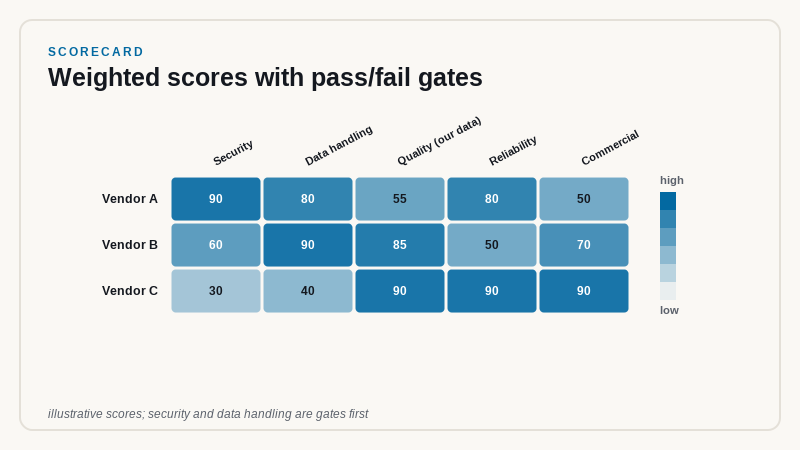
WEIGHTS = {"security": 0.25, "data_handling": 0.20, "quality": 0.30, "reliability": 0.15, "commercial": 0.10}

def total(scores):
    return sum(WEIGHTS[k] * scores[k] for k in WEIGHTS)
Set minimum thresholds for security and data handling as pass or fail gates before weighting the rest.
Questions that separate substance from slides
- Show us a failure. What does a bad answer look like, and how do you detect and handle it?
- How do you evaluate quality, and can we see your results on tasks like ours?
- What changed in your product in the last six months that affected customers?
- Which parts of the product do you build, and which do you resell or wrap?
- How do you handle a customer who wants to leave?
Evaluating claims about accuracy
Be skeptical of a single accuracy figure without a description of the data and the method. Ask what the test set contained, whether it resembles your documents, and who graded the results. Replace claims with your own test.
Running the pilot
PILOT_CHARTER = {
  "duration_days": 30,
  "dataset": "50 anonymized real cases, held by us",
  "success": {"quality_min": 0.85, "p95_latency_s_max": 5, "security_review": "pass"},
  "exit_rights": "terminate without penalty; data deleted within 30 days",
}
The numbers are examples. Set yours before the pilot starts, and share them with the vendor so there are no surprises.
Reference checks
Speak with two or three customers of similar size and sector. Ask about onboarding effort, support quality, surprises in pricing, and whether they would buy again. Ask how the vendor behaved when something went wrong.
Red flags
- Reluctance to share security documentation or subprocessor lists.
- Vague answers about training on customer data.
- Pricing that is opaque at your volume.
- Refusal to run a pilot on your data.
- No clear data export or deletion process.
After selection
Negotiate the contract with the pilot evidence in hand. Set service levels, reporting, and a regular review meeting. Plan the integration and a measured rollout, and keep your evaluation set, so you can test the vendor's next release before it reaches your users.
How we can help
We act as your independent technical evaluator: we run the security questionnaire, build the test set, run the pilot comparison, and review the contract terms with you. Contact us to start a vendor evaluation.
Related reading
Need help implementing this?
Our consultants run architecture reviews and build production pilots. Book a free scoping call to talk through your design.
Book a Free Scoping Callor email us at hello@deepvero.com