Deep Dive · Sep 29, 2026 · 7 min read
Designing Human-in-the-Loop Workflows for GenAI
Where to place review, how to route by risk and confidence, and how to turn corrections into improvements.
 Short version← Why GenAI Works Best With a Human in the Loop
Human review is not a checkbox. It is a component with its own capacity, latency, and failure modes. Design it deliberately, and use it to improve the system.
Route by risk and confidence
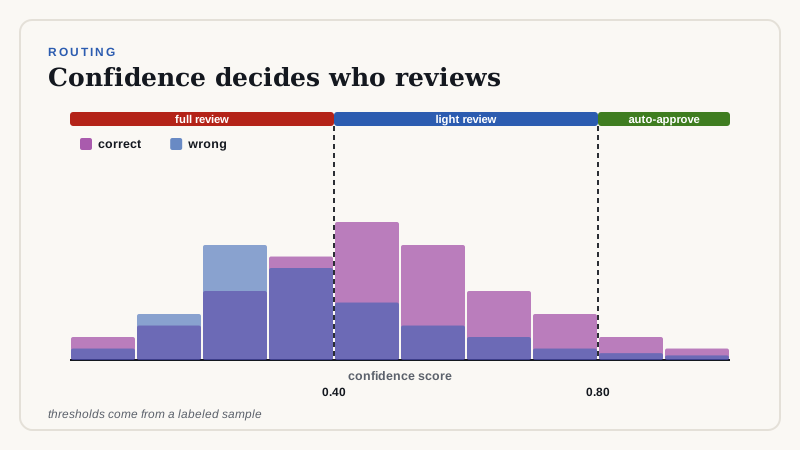
Not every output needs the same scrutiny. Combine the impact of an error with the system's confidence signals to choose auto-approve, light review, or full review.
def route(item):
    risk = item.impact          # "low" | "medium" | "high" from business rules, not from the model
    conf = item.confidence      # 0..1 from retrieval score, self-check, and validators
    if risk == "high":
        return "full_review"
    if risk == "medium":
        return "light_review" if conf >= 0.8 else "full_review"
    return "auto_approve" if conf >= 0.9 else "light_review"
Thresholds are starting points. Calibrate them by measuring, on a labeled sample, how often each route's outputs are actually wrong.
Confidence signals
- Retrieval similarity of the best supporting passage.
- Whether citations verify against sources.
- Agreement between two independent generations.
- Rule-based validators, such as totals that must add up.
Review UX
- Show the output with its sources side by side.
- Make approve, edit, and reject one click each.
- Capture a reason code on rejections.
- Do not show the model's confidence as a number that invites blind trust.
Capacity planning
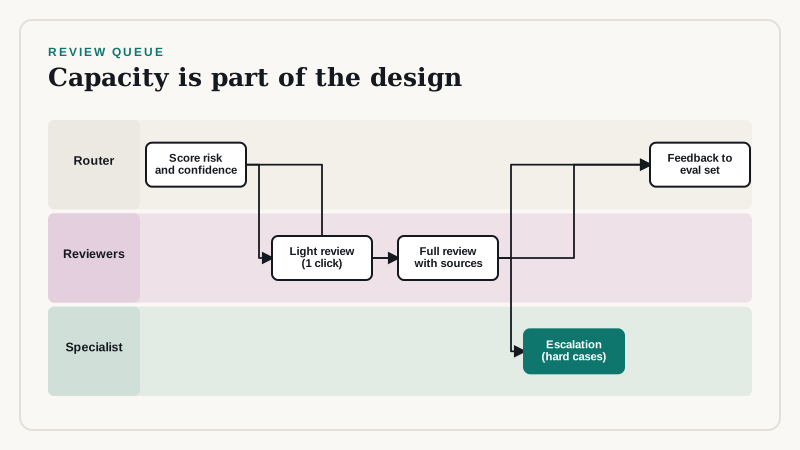
If reviewers cannot keep up, the queue grows and the benefit disappears. Estimate arrival rate, review time, and staffing, and set the routing so that review volume fits capacity.
Learn from corrections
def log_review(store, item, decision, final_text, reason=None):
    store.insert({
        "item_id": item.id, "model_output": item.text, "decision": decision,
        "final_text": final_text, "edit_ratio": edit_ratio(item.text, final_text),
        "reason": reason, "route": item.route,
    })
Review the highest edit-ratio items each week. Fix root causes in sources, retrieval, or prompts, and add the cases to the evaluation set.
Avoid automation complacency
Reviewers who approve nearly everything stop looking. Seed the queue with known-bad items and measure whether they are caught.
Calibrating the router
Thresholds should come from data. Take a labeled sample of outputs with their confidence signals and the correct outcome, then compute, for each threshold, how many outputs would be auto-approved and how many of those would be wrong. Choose the threshold that keeps the error rate in the auto-approved group below what the business accepts.
def threshold_report(items, thresholds):
    rows = []
    for t in thresholds:
        auto = [i for i in items if i["confidence"] >= t]
        wrong = sum(1 for i in auto if not i["correct"])
        rows.append({"threshold": t, "auto_share": len(auto) / len(items),
                     "error_rate_in_auto": wrong / len(auto) if auto else None})
    return rows
Reviewer experience and fatigue
- Keep queues short and sorted by risk and age.
- Give reviewers context: sources, history, and the reason an item was flagged.
- Rotate review work, and cap continuous review time.
- Measure reviewer agreement on a sample, because disagreement between reviewers is a signal that guidelines are unclear.
Writing review guidelines
Guidelines turn judgment into consistency. Define what an acceptable output looks like with positive and negative examples, what to do for each type of problem, and when to escalate. Review the guidelines monthly using the disagreements you observe.
Escalation paths
Reviewers need somewhere to send hard cases. Define a path to a specialist with a response time, and track the volume. A rising escalation rate can show that the system is drifting into areas it was not designed for.
Audit and accountability
Record who approved what and when, the version of the system that produced the draft, and any edits. If something goes wrong, you can explain the decision chain. Make clear in policy that the reviewer, not the model, is accountable for approved output, and give them the time and authority to do it properly.
Changing the level of automation
Move an item type from full review to light review, and from light review to automatic approval, only after a defined period of measured performance. Move back if quality drops. This keeps automation tied to evidence, and gives people confidence that the system is earning its autonomy.
How we can help
We design review workflows and routing for GenAI systems, including the reviewer interface and the metrics. Talk to us about adding controlled human oversight to your pilot.
Related reading
Need help implementing this?
Our consultants run architecture reviews and build production pilots. Book a free scoping call to talk through your design.
Book a Free Scoping Callor email us at hello@deepvero.com