Deep Dive · Oct 5, 2026 · 7 min read
Five GenAI Patterns and Their Technical Blueprints
Reference blueprints for the five projects that ship fastest: support, document Q&A, drafting, search, and reporting.
 Short version← 5 GenAI Projects Your Business Can Ship in 30 Days
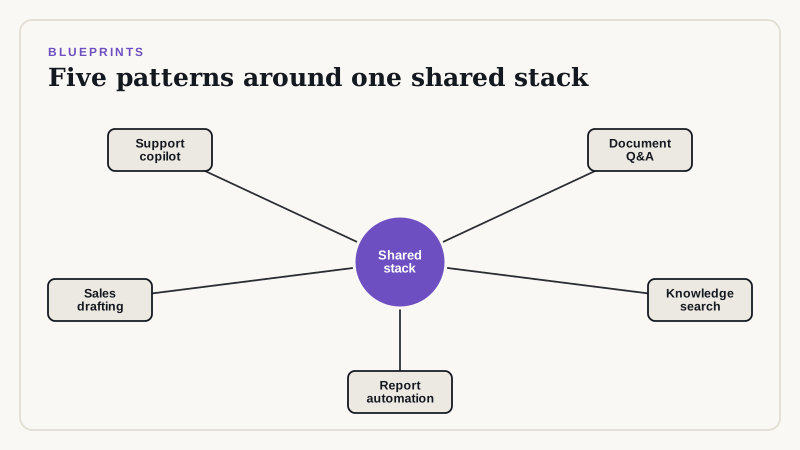
The five projects in the short post share a small set of building blocks. Knowing the blueprint makes scoping and estimating far more accurate.
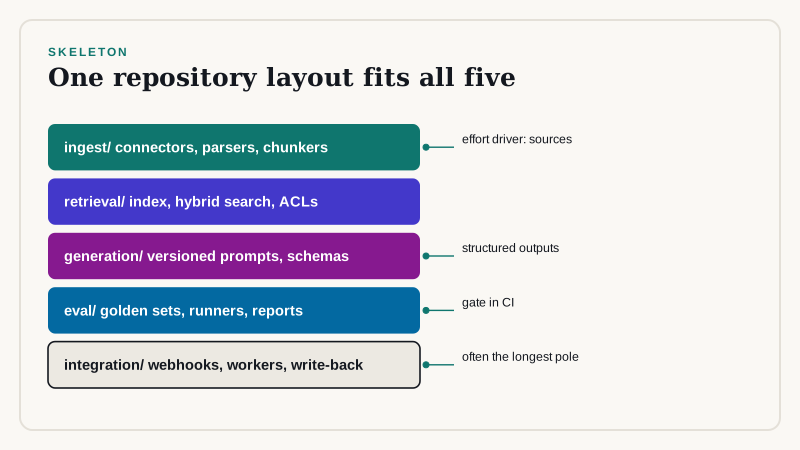
Shared building blocks
- Ingestion: connectors, parsing, chunking, metadata.
- Retrieval: hybrid search with permission filters.
- Generation: prompt templates with structured output.
- Evaluation: golden sets and regression runs.
- Delivery: integration into an existing tool.
1. Support copilot
Ticket in, retrieved articles and past resolutions, drafted reply, agent review. Key risk: stale knowledge. Key metric: edit distance and time to resolution.
2. Document Q&A
Chunked and permissioned index, hybrid search, cited answers. Key risk: wrong or uncited claims. Key metric: retrieval recall and citation validity.
3. Sales and outreach drafting
CRM and call transcript in, structured summary and email draft out. Key risk: invented facts about the customer. Key metric: acceptance rate.
{
  "summary": "string, max 80 words",
  "next_steps": [{"owner": "string", "action": "string", "due": "YYYY-MM-DD or null"}],
  "follow_up_email": "string",
  "facts_used": ["quote from the transcript supporting each claim"]
}
4. Internal knowledge search
Connectors to wiki, chat, and drives, with per-source permissions. Key risk: leaking restricted content. Key metric: success rate on real questions.
5. Report automation
Pull figures with SQL or an API, generate narrative around them, and verify every number against the source. Never let the model compute or type figures itself.
def narrate(figures: dict, gateway):
    allowed = {f"{k}={v}" for k, v in figures.items()}
    text = gateway.complete("report", "large", prompt_with(figures), temperature=0.2).text
    for number in extract_numbers(text):
        if number not in {str(v) for v in figures.values()}:
            raise ValueError(f"unverified number in narrative: {number}")
    return text
Estimating effort
The ingestion and integration pieces dominate effort, not the model call. Count the sources, the formats, and the systems to integrate, then multiply by experience from similar builds.
Choosing between the five
Match the pattern to your data and your risk tolerance. Document-centric organizations usually start with Q&A or knowledge search. Customer-facing teams start with a support copilot. Revenue teams start with drafting. Finance and operations start with report automation. All five reward the same early investment in a clean source and an evaluation set.
Estimating effort per pattern
- Support copilot: effort is dominated by the helpdesk integration and the knowledge cleanup.
- Document Q&A: ingestion and permissions are the large items, then retrieval tuning.
- Sales drafting: integration with call recording and the CRM, then extraction accuracy.
- Knowledge search: number of sources and their permission models.
- Report automation: access to governed data and the reconciliation checks.
A shared project skeleton
project/
  ingest/          # connectors, parsers, chunkers
  retrieval/       # indexing, hybrid search, access filters
  generation/      # prompts (versioned), schemas, validators
  eval/            # golden sets, runners, reports
  integration/     # webhooks, queue workers, write-back
  ops/             # dashboards, alerts, runbooks
Pitfalls that appear in every pattern
- Skipping the evaluation set, and so never knowing whether a change helped.
- Underestimating integration, permissions, and data cleanup.
- Letting the model produce figures, dates, or identifiers that code could supply.
- Launching to everyone at once instead of a pilot group.
- No owner for content, so the system quietly goes stale.
A 30-day plan that fits any of them
- Week 1: choose the pattern, define success numerically, collect data and cases.
- Week 2: working prototype on real data, end to end.
- Week 3: evaluation, failure analysis, safeguards, and integration.
- Week 4: pilot with a small group, measure, and decide on next steps.
Thirty days is achievable when scope is narrow and access is ready on day one. If data access takes three weeks to arrange, plan for it; it is the most common cause of delay.
How we can help
We deliver these patterns as fixed-scope pilots, typically in about 30 days, with the evaluation set and the integration included. Contact us to pick the right one for your data.
Related reading
Need help implementing this?
Our consultants run architecture reviews and build production pilots. Book a free scoping call to talk through your design.
Book a Free Scoping Callor email us at hello@deepvero.com